Transcribed
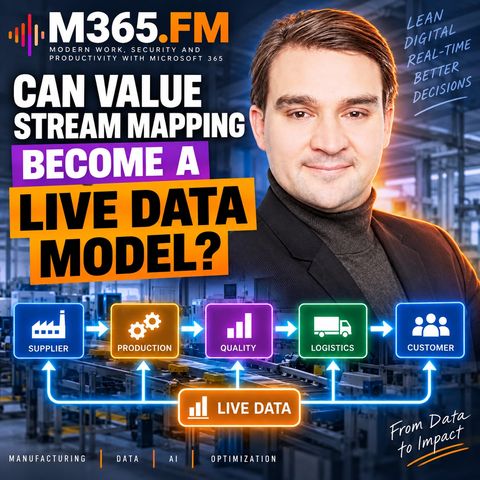
Can Value Stream Mapping Become a Live Data Model?
Sep 15, 2026 ·
1h 48m 31s
Download and listen anywhere
Download your favorite episodes and enjoy them, wherever you are! Sign up or log in now to access offline listening.
Can Value Stream Mapping Become a Live Data Model?
Description
Value Stream Mapping has been one of the most useful tools in Lean Manufacturing for understanding how material, information, and decisions move through a production system.But traditional Value Stream Mapping...
show more
Value Stream Mapping has been one of the most useful tools in Lean Manufacturing for understanding how material, information, and decisions move through a production system.But traditional Value Stream Mapping has a fundamental limitation.The factory keeps changing. The map does not.You can bring production, planning, quality, maintenance, supply chain, and operations into the same workshop. You can map cycle times, queues, batch sizes, handoffs, waiting times, information flows, and bottlenecks. At the end of the workshop, everyone may finally share the same picture of how the production system works.Then reality changes.A supplier shipment arrives late. A customer places an urgent order. A machine goes down. Quality blocks a batch. Maintenance removes a resource from production. A setup takes longer than expected. Material waits in the wrong location.The Value Stream Map hanging on the wall still describes yesterday's factory.So what if a Value Stream Map could become something more?In this episode, we explore how Value Stream Mapping could evolve from a static Lean Manufacturing document into a live manufacturing data model connected to ERP, MES, quality, maintenance, machine, and shop-floor data.The goal is not simply to digitize a Value Stream Map.The goal is to create a model that continuously reflects how production actually behaves.
THE PROBLEM WITH STATIC VALUE STREAM MAPPING
Traditional Value Stream Mapping captures an important snapshot of a production system.It helps teams understand the sequence of processes required to produce a product, but its real value goes much further than drawing boxes and arrows.A Value Stream Map can describe processing times, waiting times, queues, inventory, batch sizes, changeovers, information flows, replenishment signals, production control rules, and handoffs between different parts of the organization.That makes Value Stream Mapping extremely useful for understanding flow.But production is dynamic.The conditions captured during a workshop may already be different several days later.Demand changes.Resources become unavailable.Orders receive different priorities.Quality issues create rework.Material arrives late.Production schedules change.Actual cycle times differ from planning assumptions.These changes affect the real flow of production, but they are usually not reflected automatically in the Value Stream Map.This creates an interesting question for modern manufacturing:Can Value Stream Mapping become a continuously updated model of the factory?
FROM VALUE STREAM MAP TO LIVE DATA MODEL
A live Value Stream Model would be fundamentally different from simply putting a traditional Value Stream Map on a screen.Digitizing a diagram is relatively easy.Creating a model that understands the relationships between orders, operations, resources, materials, constraints, events, and production states is much harder.A live manufacturing model needs to understand questions such as:Where is an order right now?Which operation was completed last?What should happen next?Which resource is required?Is that resource actually available?Is material waiting?Is quality blocking production?Has maintenance reduced available capacity?Is the order waiting because of a physical constraint or because of an information delay?And most importantly:What evidence proves the current state of production?This moves Value Stream Mapping from documentation toward operational intelligence.
ONE ORDER, MANY MANUFACTURING SYSTEMS
Consider a make-to-order manufacturing environment.A customer order enters the business with a required delivery date.ERP creates the sales order, generates production requirements, checks material availability, and provides routing information describing the expected sequence of operations.But ERP only provides part of the picture.On the factory floor, the Manufacturing Execution System may dispatch work, record operator confirmations, track production progress, and maintain serial or batch information.Machine systems provide another perspective.A machining center might report whether it is running, idle, faulted, or currently being set up.A furnace might provide temperature information and cycle completion events.A test station might generate pass or fail results.Industrial gateways, historians, PLCs, and IoT systems may collect additional operational signals.Quality systems add another layer.An inspection result might place material on hold.A nonconformance could trigger rework.A quality release may happen hours after the physical inspection has already finished.Maintenance systems also influence the real production schedule.A machine might technically appear available in the planning system while scheduled maintenance makes it unavailable for several hours.Each system contains valuable information.But none of those systems alone necessarily describes the complete production flow.
WHERE DID THE LEAD TIME ACTUALLY GO?
Imagine an order that ships late.ERP knows when the order was created.ERP knows the planned delivery date.MES knows when individual operations were confirmed.Machine data may show when equipment was running.Quality systems know when inspections happened.Maintenance knows when resources were unavailable.But the planner asks a much simpler question:Why was this order late?Where did the lead time actually go?Maybe the order waited after machining.Maybe material was physically ready but transport did not move it.Maybe inspection was completed but the quality release happened hours later.Maybe a machine had capacity but the required material was waiting somewhere else.Maybe too much work was released upstream, creating a queue in front of the real constraint.Maybe the production schedule was already unrealistic when the order entered the shop floor.The data required to answer these questions may already exist.The problem is that it exists across multiple systems.
ERP DATA IS NOT THE SAME AS PRODUCTION REALITY
ERP systems are essential for manufacturing.They manage orders, materials, routings, requirements, inventory, purchasing, and many other business processes.But an ERP routing describes how production is expected to happen.It does not automatically describe what is physically happening on the factory floor right now.That distinction becomes critical when manufacturers want to optimize production.A production plan may say that an order can move to the next operation.The factory may say something completely different.The machine may be unavailable.Material may not have arrived.An operator may not be available.Quality may have blocked the batch.The previous operation may have taken longer than expected.Another urgent order may already occupy the resource.The planned production model and the actual production system can quickly diverge.A live Value Stream Model could help expose that difference.
WHY MES ALONE IS NOT ENOUGH
MES provides much deeper production visibility than ERP.It can track work orders, operations, confirmations, production progress, genealogy, and shop-floor execution.But MES also represents only part of the manufacturing environment.Production decisions may depend on information stored outside the MES.Quality systems.Maintenance systems.Warehouse systems.Industrial IoT platforms.Machine historians.Planning systems.Scheduling systems.ERP.Operator input.Transportation systems.Even spreadsheets may still contain operational information that influences production.A live manufacturing model therefore needs relationships between these systems rather than simply another isolated dashboard.
REAL-TIME DASHBOARDS ARE NOT LIVE VALUE STREAMS
Many digital manufacturing projects focus on real-time visibility.Machine states are collected.Production data enters a lakehouse.Dashboards display open orders.Power BI visualizes KPIs.Managers receive more current information.That can be extremely valuable.But real-time data alone does not automatically create a live Value Stream.Knowing that a machine is idle does not explain why material is waiting.Knowing that an order is open does not explain which constraint prevents it from progressing.Knowing that an operation is delayed does not automatically reveal whether the cause is capacity, material, quality, maintenance, sequencing, transportation, or information flow.A dashboard shows information.A model describes relationships.That distinction becomes increasingly important when manufacturers want to move from visibility toward optimization.
CONNECTING IT AND OT DATA
One of the biggest challenges in modern manufacturing is connecting Information Technology and Operational Technology.Business systems understand customers, orders, materials, costs, and delivery dates.Operational systems understand machines, process states, events, faults, temperatures, cycle times, and physical production.The production system sits between those worlds.A customer order eventually becomes physical work.A routing becomes machine operations.A production schedule becomes actual sequences.A planned cycle time becomes a measured cycle time.A planned resource becomes a real machine with downtime, maintenance, setups, and capacity constraints.A live Value Stream Model could provide a semantic layer connecting those perspectives.
Become a supporter of this podcast: https://www.spreaker.com/podcast/m365-fm-a-microsoft-mvp-podcast-by-mirko-peters--6704921/support.
show less
THE PROBLEM WITH STATIC VALUE STREAM MAPPING
Traditional Value Stream Mapping captures an important snapshot of a production system.It helps teams understand the sequence of processes required to produce a product, but its real value goes much further than drawing boxes and arrows.A Value Stream Map can describe processing times, waiting times, queues, inventory, batch sizes, changeovers, information flows, replenishment signals, production control rules, and handoffs between different parts of the organization.That makes Value Stream Mapping extremely useful for understanding flow.But production is dynamic.The conditions captured during a workshop may already be different several days later.Demand changes.Resources become unavailable.Orders receive different priorities.Quality issues create rework.Material arrives late.Production schedules change.Actual cycle times differ from planning assumptions.These changes affect the real flow of production, but they are usually not reflected automatically in the Value Stream Map.This creates an interesting question for modern manufacturing:Can Value Stream Mapping become a continuously updated model of the factory?
FROM VALUE STREAM MAP TO LIVE DATA MODEL
A live Value Stream Model would be fundamentally different from simply putting a traditional Value Stream Map on a screen.Digitizing a diagram is relatively easy.Creating a model that understands the relationships between orders, operations, resources, materials, constraints, events, and production states is much harder.A live manufacturing model needs to understand questions such as:Where is an order right now?Which operation was completed last?What should happen next?Which resource is required?Is that resource actually available?Is material waiting?Is quality blocking production?Has maintenance reduced available capacity?Is the order waiting because of a physical constraint or because of an information delay?And most importantly:What evidence proves the current state of production?This moves Value Stream Mapping from documentation toward operational intelligence.
ONE ORDER, MANY MANUFACTURING SYSTEMS
Consider a make-to-order manufacturing environment.A customer order enters the business with a required delivery date.ERP creates the sales order, generates production requirements, checks material availability, and provides routing information describing the expected sequence of operations.But ERP only provides part of the picture.On the factory floor, the Manufacturing Execution System may dispatch work, record operator confirmations, track production progress, and maintain serial or batch information.Machine systems provide another perspective.A machining center might report whether it is running, idle, faulted, or currently being set up.A furnace might provide temperature information and cycle completion events.A test station might generate pass or fail results.Industrial gateways, historians, PLCs, and IoT systems may collect additional operational signals.Quality systems add another layer.An inspection result might place material on hold.A nonconformance could trigger rework.A quality release may happen hours after the physical inspection has already finished.Maintenance systems also influence the real production schedule.A machine might technically appear available in the planning system while scheduled maintenance makes it unavailable for several hours.Each system contains valuable information.But none of those systems alone necessarily describes the complete production flow.
WHERE DID THE LEAD TIME ACTUALLY GO?
Imagine an order that ships late.ERP knows when the order was created.ERP knows the planned delivery date.MES knows when individual operations were confirmed.Machine data may show when equipment was running.Quality systems know when inspections happened.Maintenance knows when resources were unavailable.But the planner asks a much simpler question:Why was this order late?Where did the lead time actually go?Maybe the order waited after machining.Maybe material was physically ready but transport did not move it.Maybe inspection was completed but the quality release happened hours later.Maybe a machine had capacity but the required material was waiting somewhere else.Maybe too much work was released upstream, creating a queue in front of the real constraint.Maybe the production schedule was already unrealistic when the order entered the shop floor.The data required to answer these questions may already exist.The problem is that it exists across multiple systems.
ERP DATA IS NOT THE SAME AS PRODUCTION REALITY
ERP systems are essential for manufacturing.They manage orders, materials, routings, requirements, inventory, purchasing, and many other business processes.But an ERP routing describes how production is expected to happen.It does not automatically describe what is physically happening on the factory floor right now.That distinction becomes critical when manufacturers want to optimize production.A production plan may say that an order can move to the next operation.The factory may say something completely different.The machine may be unavailable.Material may not have arrived.An operator may not be available.Quality may have blocked the batch.The previous operation may have taken longer than expected.Another urgent order may already occupy the resource.The planned production model and the actual production system can quickly diverge.A live Value Stream Model could help expose that difference.
WHY MES ALONE IS NOT ENOUGH
MES provides much deeper production visibility than ERP.It can track work orders, operations, confirmations, production progress, genealogy, and shop-floor execution.But MES also represents only part of the manufacturing environment.Production decisions may depend on information stored outside the MES.Quality systems.Maintenance systems.Warehouse systems.Industrial IoT platforms.Machine historians.Planning systems.Scheduling systems.ERP.Operator input.Transportation systems.Even spreadsheets may still contain operational information that influences production.A live manufacturing model therefore needs relationships between these systems rather than simply another isolated dashboard.
REAL-TIME DASHBOARDS ARE NOT LIVE VALUE STREAMS
Many digital manufacturing projects focus on real-time visibility.Machine states are collected.Production data enters a lakehouse.Dashboards display open orders.Power BI visualizes KPIs.Managers receive more current information.That can be extremely valuable.But real-time data alone does not automatically create a live Value Stream.Knowing that a machine is idle does not explain why material is waiting.Knowing that an order is open does not explain which constraint prevents it from progressing.Knowing that an operation is delayed does not automatically reveal whether the cause is capacity, material, quality, maintenance, sequencing, transportation, or information flow.A dashboard shows information.A model describes relationships.That distinction becomes increasingly important when manufacturers want to move from visibility toward optimization.
CONNECTING IT AND OT DATA
One of the biggest challenges in modern manufacturing is connecting Information Technology and Operational Technology.Business systems understand customers, orders, materials, costs, and delivery dates.Operational systems understand machines, process states, events, faults, temperatures, cycle times, and physical production.The production system sits between those worlds.A customer order eventually becomes physical work.A routing becomes machine operations.A production schedule becomes actual sequences.A planned cycle time becomes a measured cycle time.A planned resource becomes a real machine with downtime, maintenance, setups, and capacity constraints.A live Value Stream Model could provide a semantic layer connecting those perspectives.
Become a supporter of this podcast: https://www.spreaker.com/podcast/m365-fm-a-microsoft-mvp-podcast-by-mirko-peters--6704921/support.
Information
| Author | Mirko Peters (M365 Consultant) |
| Organization | m365 FM |
| Website | - |
| Tags |

Copyright 2026 - Spreaker Inc. an iHeartMedia Company

Comments