Structural Steel Fabrication Process: Complete Guide
Oct 14, 2026 ·
7m 27s
Download and listen anywhere
Download your favorite episodes and enjoy them, wherever you are! Sign up or log in now to access offline listening.
Description
Transforming raw steel into critical structural components for skyscrapers, refineries, and infrastructure requires a level of engineering precision akin to watchmaking on a massive scale. To ensure long-term structural integrity...
show more
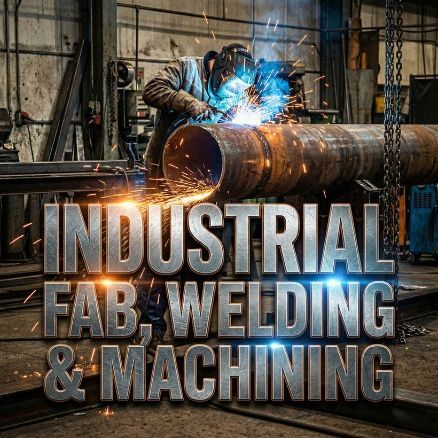
Transforming raw steel into critical structural components for skyscrapers, refineries, and infrastructure requires a level of engineering precision akin to watchmaking on a massive scale. To ensure long-term structural integrity and dimensional accuracy, fabricators must integrate 3D Building Information Modeling (BIM), rigorous material selection, advanced thermal and non-thermal cutting technologies, and AWS-certified welding protocols.On this episode of Industrial Fab, Welding & Machining, the fabrication specialists at LTJ Industrial Services break down the multi-stage structural steel manufacturing process—from initial CAD modeling and metallurgical selection through CNC cutting, stress relief, and corrosion protection.Technical Comparison: Thermal & Non-Thermal Cutting Methodologies
click here
Learn more about LTJ Industrial Services at www.ltjindustrial.com/
show less
- Oxy-Fuel Cutting:
- Material Range & Capability: Highly effective for thick carbon steel plates (typically 1 inch up to 12+ inches).
- Metallurgical Impact: Generates a substantial Heat-Affected Zone (HAZ) and thermal distortion, requiring edge dressing for critical joints.
- Operational Fit: Heavy industrial plate cutting where production speed on extreme thicknesses supersedes micro-tolerance requirements.
- Plasma Cutting (High-Definition CNC):
- Material Range & Capability: Optimal for medium plate thicknesses (1/4 inch to 1.5 inches) across carbon steel, stainless steel, and aluminum.
- Metallurgical Impact: Moderate HAZ with high processing speeds; provides tight beveling capabilities for weld prep.
- Operational Fit: Fast-paced production runs requiring clean bevel angles and rapid turnaround on medium structural plate.
- Waterjet Cutting (Abrasive CNC):
- Material Range & Capability: Processes virtually any plate thickness or heat-sensitive alloy without temperature alteration.
- Metallurgical Impact: Zero Heat-Affected Zone (HAZ); eliminates thermal distortion, edge hardening, and mechanical stress.
- Operational Fit: Precision components, specialty alloys, and tight-tolerance fittings where thermal alteration impairs structural performance.
- Laser Cutting (Fiber CNC):
- Material Range & Capability: Precision cutting for thin-to-medium gauge steel and structural tubing (up to 1 inch).
- Metallurgical Impact: Minimal HAZ with ultra-fine kerf width and extreme dimensional repeatability.
- Operational Fit: Intricate geometric profiles, gussets, clip angles, and high-volume structural bracketry.
- Deploy 3D BIM Modeling and CNC Nesting: Convert structural framing blueprints into 3D models to auto-generate G-code for CNC cutting systems, optimizing material yield and catching spatial interferences early.
- Execute Material Verification and Traceability Audits: Validate incoming steel against Mill Test Reports (MTRs) to confirm tensile, yield, and chemical composition (e.g., ASTM A36 for general structural framing vs. ASTM A588 weathering steel for atmospheric corrosion resistance).
- Manage Form-Bending Springback & Thermal Stresses: Calculate material springback prior to press brake operations, and apply controlled heat treatment or mechanical stress relief on heavy section bends to maintain strict dimensional tolerances.
- Enforce AWS D1.1 Welding & Surface Coating Standards: Utilize verified Welding Procedure Specifications (WPS), execute tack-weld fit-ups within code tolerances, perform abrasive blasting to SSPC surface profiles, and apply multi-coat zinc/epoxy protective systems.
- The Scale of Structural Precision: Turning raw steel into heavy industrial infrastructure.
- 3D BIM Modeling & Material Selection: Eliminating drafting errors and matching steel grades (ASTM A36 vs. A588) to environmental demands.
- CNC Cutting Technologies Compared: Oxy-fuel, high-definition plasma, laser, and zero-HAZ waterjet cutting.
- Forming, Bending & Springback Dynamics: Managing mechanical stress during press brake and roll forming operations.
- AWS D1.1 Quality Assurance: Welding Procedure Specifications (WPS), fit-up tolerances, and heat distortion control.
- Surface Preparation & Protective Coatings: Abrasive blasting profiles, zinc-rich primers, and intumescent fireproofing.
- Logistics & Precision Field Delivery: Packaging, RFID tagging, and partnering with LTJ Industrial Services.
click here
Learn more about LTJ Industrial Services at www.ltjindustrial.com/
Information
| Author | Don Markland |
| Organization | Don Markland |
| Website | - |
| Tags |

Copyright 2026 - Spreaker Inc. an iHeartMedia Company

Comments