Info
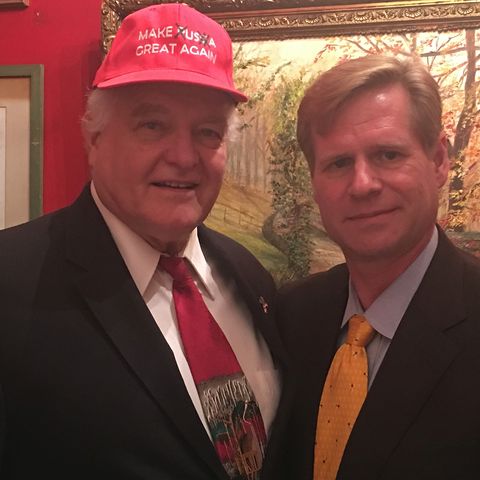
A look at Louisiana politics from Chaplain Hy McEnery and Christopher Tidmore
Episodes & Posts
Episodes
Posts
Transcribed
28 AUG 2026 · Christopher broadcasts live from Juneau, Alaska on this week’s edition of The Founders Show. He and Hy talk melting glaciers, and how that could raise flood waters in South Louisiana, and the urgent needs to build flood protection to deal with a possible increase of four feet in ocean levels. That alone would make Mandeville, Tangipahoa, Slidell, and most of the South Shore outside of the ‘sliver by the river’ go underwater.
We talk about Trump‘s renaming of Lake Ontario to Lake American. Prime Minister Mark Carney fired back, “The name Lake Ontario comes from the Wendat word Ontario, which, appropriately, means "the lake is beautiful, the lake is big". The name is more than 400 years old, predating both the Confederation of Canada and the Declaration of Independence of the United States of America. We know that America is changing. Their trading relationships, their foreign policies, their national monuments, their.hydronyms. Canadians also know that naming reality means calling it Lake Ontario- then, now and always.”
However, most of our conversation is about the new potential 10 pad “Starbase Louisiana” announced earlier this week— and a bit of negative local reaction.
It’s Rocketmen v. Cajuns. Since SpaceX’s announcement on Tuesday, August 25 that the company plans to construct a rocket launch facility at Pecan Island, critics have fired back with multiple impact environmental concerns. However, these objections pale in comparison to the anxieties of some local residents of Vermillion Parish wondering whether the new “multicultural” high income transplants who might move into their communities could upset the “balance”—as it was referred to in (at least) one public forum last week. “Multicultural invaders”, they have been so labeled, a curious moniker for the potential influx of hundreds of high-tech workers to build and operate the $100 billion ‘Starbase Louisiana’ project. “Outsiders” overtaking their small Cajun communities, some locals have gushed, hiding behind concerns that highly paid SpaceX employees could boost housing costs in the greater Abbeyville and that new schools may need to be built to handle the influx of children. More than a few area-locals even have uttered that their community will not “look” the same. Ironically, much of the Vermillion Parish region has lingered in an economic depression for decades, effectively since the oil boom of the 1970s. Small towns thoughout have watched their young people depart, year after year, not just for major cities in this state, but economic opportunities elsewhere across the US. Until recently, the local school board members worried about closing schools due to lack of potential pupils— a frequent challenge their colleagues have faced across Louisiana. It almost seems farce, then, to read social media posts complaining that highly paid potential employees of SpaceX might displace local school children and swallow up housing in the South Louisiana Parish. Opponents of the proposed launch facility actually view in-migration as a bigger problem than many other legitimate questions— including the potential environmental impact of pillars of fire. The Acadian majority of Vermillion Parish might wish to remember that 260 years ago, they themselves formed the massive influx of new settlers displacing the millennias-old cultures populating the wetlands, and these Cajun pioneers entered Louisiana with a five-year guaranteed subsidy paid by the Spanish crown as a means to displace and tame those native tribes. In fairness, Cajuns themselves were the original victims of ethnic cleansing, and they rebuilt their once-Nova Scotian society into a key thread the cultural fabric of Louisiana. Other newcomers can bring their own thread enriching the cultural tapestry as well. For Cajuns to imply otherwise displays an extreme degree of historical hypocrisy— as such cultural chauvinism would for most Americans. Nearly everyone was a newcomer to this continent, after all. The current ones are not just all white. How igniting rocket launches could affect wetlands does constitute a reasonable concern, though. SpaceX’s sonic booms so bothered communities in Cameron County, Texas, that locals there actually filed a lawsuit against the company. That could not happen here, thanks to Louisiana Act 874. Effective June 8, 2026 and passed at Governor Jeff Landry’s behest, the new law shields aerospace companies from liability, stating, “If an aerospace company owns and occupies at least 20,000 contiguous acres in Louisiana, it generally cannot be held liable for claims based on disturbances from aerospace activities.” The legislation’s stated categories include Noise & Sonic Booms, Vibration, Light, Heat, Exhaust & Smoke, Odors, Visual intrusion, as well as Temporary access restrictions or "any other disturbance" resulting from aerospace activities. It suffices to say, Act 874 defines "aerospace activities" very broadly. Nonetheless, that does not automatically mean that the environmental impact of rocket launches constitute more of a negative impact than the existing oil platforms which dot the marshes across Vermilion Parish. Similar fiery takeoffs at the NASA facility at Cape Canaveral, Florida over the last 70 years (which contains a comparable open amount of marshland, soil, and habitat very similar to Pecan Island) has done little to stop the (unintended) creation of one of the largest bird sanctuaries in the United States. Legal mandates which prevent construction near to launch platforms, cording off more than 10,000 acres of undeveloped marshlands, has actually positively impacted the numbers of many native Florida species. Similar development restrictions in the Pelican State could achieve the same. Interestingly, in whatever other ways Elon Musk’s MAGA politics might disagree with some, dollars and cents do create strange environmental allies. One of the first comments out of Musk's mouth as Starbase Louisiana was announced was that his first priority was to shore up the disappearing coastline. “Because of course it is,” the trillionaire exclaimed. “Building Starbase along the Vermilion Parish coast means there is now a $100 billion asset which needs to be protected. I mention this because there is a contingent out there - I wouldn't call them large by any means, but they're loud - of people who style themselves as environmentalists and stewards of the marshland in Vermilion Parish absolutely bawling and caterwauling about SpaceX locating at this site. And these people need to be answered as loudly as they're screaming." Of course, Musk forgot to mention that his Starbase launch facility near Boca Chica, Texas engaged in a Clean Water Act battle with its neighbors. One part of Starship operations involves a water-deluge system beneath the launch pad. The system releases large amounts of water to help manage the tremendous heat and energy generated during launches. Federal Aviation Administration documents state that the EPA and Texas Commission on Environmental Quality determined that SpaceX's deluge-water discharges into the surrounding wetlands required an individual Texas Pollutant Discharge Elimination System permit. SpaceX had previously operated under a different system, and while a subsequent agreement was reached, and the runoff mostly controlled, environmentalists continue to worry about the negative water intrusion into South Texas marshlands. Still, the economic impact of a ‘Starbase’ on Pecan Island, could revolutionize the economy of that area, especially if “new people” move to Vermilion Parish. The"spaceport" is more than just a launch pad, after all. The proposed "Chopsticks" Tower would stand 470-foot high, a massive steel structure designed to catch returning boosters mid-air. The nearby Starfactory would occupy a million-square-foot manufacturing facility creating permanent, high-wage jobs for technicians, welders, and engineers. In the end, this state’s geography, aka the ‘boot’ of Louisiana, attracted Elon Musk’s company to invest. He needed our land jutting out into the Gulf. Pecan Island offers proximity to the equator as well as clear flight paths over the water, allowing Louisiana to position itself as a global player in the new space economy, with high paying jobs not involving petroleum, fracking, or pipelines. Louisiana must vigilantly protect the environment, but slamming the door on new residents amidst prosperity runs against every tradition – Cajun and American.
Transcribed
28 AUG 2026 · This week marks the 250th anniversary of the crucial battle of Brooklyn Heights. George Washington was hemmed in by Hessan mercenaries, the British regulars, and the Royal Navy.
The recently declared independence of the United States looked to be doomed. Hy and Christopher talk about fraught the military situation had become when our Founders pen the document just a few weeks before in Philadelphia. Independence seemed anything but sure.
From Washington’s early escapes in the North, which Christopher kicks off the show discussing, to the ultimate battles in the South, which Hy recounts leading to Yorktown and America’s freedom, we dedicate this week show to the United States’ fight for independence a quarter millennium ago.
Transcribed
15 AUG 2026 · Hy and Christopher kick off the show talking about flood protection, and the need to build a levee system for South Louisiana similar to the venture global LNG plant has constructed in Plaquemines Parish— 60 feet 129 foot foundations, capable pulling out the entire Gulf. We also need a flood gate and the Chef Pass and the Rigolets.
We spend most of the show asking the question again, Cassidy Played the Fool.
Christopher at least hoped that Sen. Bill Cassidy received some major financial commitment for his constituents in Louisiana prior to August 8. Otherwise, absent of political trade-off, why would he vote for Donald Trump‘s desperately unqualified personal lawyer Todd Blanche to become Attorney General of the United States? Cassidy cast the tie-breaking vote, 50-49, to confirm Blanche despite his fellow moderate Republican Senators Susan Collins of Maine and Lisa Murkowski of Alaska opposing until the end.
The Louisiana Senator predicated his support on Blanche reaching a deal with Texas Sen. John Cornyn to nullify the $1.8 billion “Anti-Weaponization Fund” as part of Trump’s settlement with the IRS. Blanche played a key role in creating the fund for Trump allies — including Jan. 6 rioters pardoned by Trump — on Aug. 2. The fact that Cornyn, a former Texas attorney general, was “comfortable” with the deal was important to Cassidy, he said.
“What I’m told as regards to the Anti-Weaponization Fund, if you put it in the context of the political environment, the judicial environment, the process you would have to go back through in order to reinstate it, that effectively it’s dead,” Cassidy told Margaret Brennan on CBS’s “Face the Nation.” He went around to justify the vote by noting he had “a lot of positive things to say about Todd Blanche” and “stable leadership” was necessary for the DOJ to do its job.”
Then, curiously, Cassidy added in the interview, that he almost voted against Blanche for continuing to grant protection to Trump and his family from IRS probes.
“That is wrong — and no American should be targeted by the law, but no American should be above the law. And that, frankly, almost weighed to vote ‘No,’” he confessed to Brennan.
If no one is above the law, why would Cassidy support a candidate for the nation’s chief law-enforcement officer who specifically labeled the sitting president and his family ‘as above the law’? More importantly, in the future, what does that say about an independent AG who might have to investigate the executive branch?
Bill Cassidy has fallen pray to the promises of the Trump Administration before, only to have his hopes publicly dashed. As a physician, the Louisiana Senator spent most of his professional life championing vaccinations. He received a specific promise from then DHS Secretary-designate Robert F Kennedy Jr. that the current vaccination regime would be respected. Ample evidence existed that RFK would never go back on one of his major political promises, to emasculate required vaccinations in America.
That’s exactly what happened less than a week after the Blanche confirmation battle. Donald Trump issued an executive order cutting the number of diseases all children should be vaccinated against from 18 to 11. The order reaffirms the dramatic overhaul to the vaccine schedule that Secretary Kennedy announced this year. (Those changes have been blocked in court.)
How many times does Bill Cassidy have to be fooled?
At least when he sold his soul to vote for RFK Jr.’s confirmation, he still held out hope that the President might endorse his reelection. After a bruising GOP primary in May, in which Trump’s attacks rendered him into an embarrassing third place, how can Bill Cassidy trust anything that the occupant of the Oval Office says?
Even if Cassidy made a deal that we know nothing about, how can he be so obtuse as to believe that Trump will ever honor his word?
Bill Cassidy could have gone down in history as a defender of the soul of the Republican Party. He was one of the few senators to vote to convict Trump after his impeachment. He could’ve stood up to the administration on issues where there was true disagreement. He would’ve lost reelection to another Republican, but Cassidy would have kept his honor.
In the end, he lost both.
Transcribed
15 AUG 2026 · Hy and Christopher confront many topics in this edition of the show, but we begin by talking about the effective New Orleans takeover of the S&WB.
Sewerage & Water Board was created at a time when there was no municipal government, no unitary city government, big enough to construct a major sewer and drainage system. The state created the quasi-independent body as a stopgap in the 19th century, yet the lack of authority the City of New Orleans possessed over it has plagued the agency ever since. Streets often were ripped up that had been just repaired, drainage issues went unheated as there was little local public accountability, and billing remained logical only in a chiaroscuro kind of way.
On August 1, 2026, that began to change. Act 938 went into effect Saturday, Aug. 1. This state law gives the New Orleans City Council more control and oversight over the Sewerage and Water Board. Despite press reports that the City now completely “controls” the S&WB, it’s still remains an independent agency. New Orleans has not duplicated the example of Jefferson Parish in putting its drainage, pumping, and sewer systems in the same department of public works along with road repair and infrastructure management. That would be simple and straightforward—and constitutionally difficult, at least so legislator thought because of historic state investment in the agency.
Still, the Aug. 6 changes give the council oversight of the agency’s budgets and key contracts and outline communication requirements during emergencies. The City Council also requests the Louisiana Legislative Auditor Michael Waguespack perform an audit of the agency and the Civil Service commission study employee pay. The council is also asking the board, on which Mayor Helena Moreno will soon replace several members, to look into and decide whether to combine the $427,000 executive director position with the $235,000 general superintendent position. The ordinances next go to Moreno’s desk. Her administration helped craft them as well as push for the state law that allowed city leaders to make these changes. Council members have long complained that though they have been the ones people contact when they have issues with S&WB, they didn’t have much control over the state agency.
Council President JP Morrell said the council is trying to turn around public opinion of S&WB, which he said was at 14% approval, before a tax millage set to go before voters next year. If the public isn’t convinced to fund the city’s sewerage, water and drainage system, the city will be in trouble, he warned. The measures the council also passed in accordance with the state law include having the board explore meeting in council chambers rather than in a small room at their headquarters. Morrell said he thought this would encourage more public participation at board meetings, adding that over the years, he’s felt the board wasn’t in touch with the public. He said the board didn’t understand how upset people were when S&WB sent them erroneous bills for thousands of dollars, adding the agency had a policy to offer people a discount on the bills rather than forgive them. The council eventually hired a law firm to handle S&WB billing issues.
Transcribed
1 AUG 2026 · In second half of this week’s show, Hy and Christopher talk Mardi Gras parade reductions, the curious MAGA reversals on Ukraine as the Iran War (re)intensifies and Dr. Fauci pleads the 5th. But we start off — and spend most of the program - talking about how the Mayor Wants a ‘Renaissance’ on Canal, but we ask “who will provide the vision and money?”
Canal Street is New Orleans’ “great white way”, the commercial thoroughfare that defined the psychological identity of the city for more than two centuries— and it is dying. The pun was intentional, as African-Americans were denied entrances to its department stores and offices for much of Canal Street’s history. Nevertheless, the banks along the throughfare’s sides would print currency for the entire nation by 1838. The ten dollar “dix” notes, a language concession to Orleanian Francophones, subsequently would dub the entire south as the “land of the dixies”, as the bank notes would be the main financial means of exchange up and down the Mississippi valley.
Canal Street’s office-suites provided the commodities factors for much of the region’s international arbitrage. Its stores featured items unavailable for sale anywhere else. Later, by the turn of the 20th century, Canal Street would boast of the first movie theater, a vitascope hall, along with one of the first jazz performance halls, and numerous more conventional theaters. It was the Broadway before Broadway. Even well to the end of the 20th century, people still met under the clock at DH Holmes, after shopping at Maison Blanche, Kreeger’s, or Gus Mayer. A statue of the eccentric Ignatius Reilly still signifies the fictional character’s wait for his mother to pick him up under the clock to this day, yet that storefront closed decades ago. The interior is a hotel which does not even face Canal Street, and currently, the John Kennedy Toole character would more likely stand in the company of homeless drug addicts than commercial shoppers.
Despite two reconstructions of sidewalks as well as many of the physical facades dotting downtown Canal Street, businesses continue to leave and restaurants close as street peddlers and panhandlers fight to replace them. That’s the depredation Mayor Helena Moreno has pledged to reverse. In a press conference on July 28, flanked by stakeholders like retailer Kenny Rubenstein, she called for a “Canal Street Renaissance”, focusing on greater public safety coordination; comprehensive lighting repairs; enhanced code enforcement targeting noncompliant properties; Business and stakeholder engagement to support economic revitalization opportunities; and quality of life improvements.
Future Phases plan to center upon Improving pedestrian safety and traffic operations; expanding arts, entertainment, and cultural programming; recruiting new retailers and creating incentives to fill vacant storefronts; coordinated branding and marketing of Canal Street; as well as activating upper-floor residential, hotel, and office spaces. From a policing standpoint, increased patrols have lead NOPD to make 23 narcotics arrests, better parking and traffic enforcement, as well as conducting quality-of-life sweeps along the corridor. Still, legal changes are necessary before much more can begin to shine again. Occupation of the (mostly empty) upper floors of buildings run into city fire code regulations requiring to exits on either side of the building. Single floor walkups (built in a very different era) do not comply, and only massive changes in zoning laws might make a difference. That, of course, does fall under the regulatory purview of the City Council, if it chooses to act.
Nevertheless, the Mayor’s other ambitious plans require even greater interventions. The incredible cost of retail operations would likely require. some form of tax inducement funding or TIFs, essentially giving back sales taxes collected to help finance the creation of the store. Massive planning, and likely low interest government subsidize loans, may prove the only way to redevelop the tragic footprint of the one time Hard Rock Hotel disaster as anything which might accentuate the quality of life of Canal Street. Equally, Canal Street does possess the core of an entertainment corridor with the Saenger and the Orpheum, but other wonderful performance spaces like the State Palace Theatre remain shuttered 20 years after Katrina, dwarfing the street’s “Broadway” potential. Huge piles government money to reconstruct, theaters and incentivize shows might be the only way to spark a life performance Renaissance— thanks to Gov. Jeff Landry‘s murder of the live performance tax credit renewal in the last legislative session.
An opportunity exists in the blocks of parking lots stretching from Canal Street to the old Big Charity complex. The lower part of Canal near the Claiborne Avenue overpass is plagued by nearly abandoned office buildings and former medical complexes flanking the asphalt-field. However, that footprint possesses one critical remaining historic structure from the Faubourg Ste. Marie, the home of the author Lafcadio Hearn. This classic building set in the middle of the parking lots could easily be transformed into the centerpiece of a reimagined public square leading to the rehabilitated Charity complex. In fact, transferring the entire area to Tulane University might provide the best use of lower Canal. Buy out lot-owner Jim Huger and transform the parking lots into a new university quad with most of Tulane’s biomedical and science-based graduate schools taking up the occupied buildings surrounding the footprint from Canal to Charity. The current medical core of Tulane Avenue could link to the commercial core of Canal Street creating a massive university complex— supporting the pedestrian and retail revitalization closer to the river.
Nevertheless, such a project would swallow up money that the City’s empty Treasury cannot fund in the immediate future. The visionary costs may prove less long-term, though, than an acknowledgment that the corporate money-men of the CBD no longer walk to Canal for three martini lunches or shopping excursions. Such a corporate infrastructure no longer exists in downtown New Orleans, so to reimagine the future of Canal Street requires an embrace of an entirely new employment vision.
The Moreno Administration’s efforts to improve traffic-signal timing, repair pedestrian crossing signals, analyze loading zones, and repave portions of Canal Street may make the thoroughfare more pedestrian friendly, but it will do little to bring back pedestrians. That will take money and a much bigger vision than trying to return to a commercial past that no longer exists. (And for many African-Americans never existed.)
In truth, a fundamental reimagination of the entire down-river CBD may serve as the only means of restoring the attraction of Canal Street, and the question remains if Helena Moreno and her team possess the political will— amidst the many other problems they confront— to TRULY to prioritize a rebirth for New Orleans’ iconic Champs-Élysées.
Transcribed
25 JUL 2026 · This week, Hy and Christopher take on the rise of AOC’s presidential chances and the socialist takeover of the Democratic Party. Is it a LEFT-WING mirror of MAGA?
We also talk about development along Lake Pontchartrain and at West End, as well as Jefferson Parish’s seemingly permanent lack of a bond rating.
But most of the show centers around Jeff Landry’s attempt to take over the New Orleans court system, and how any legislative special session hinges on Rep. Stephanie Hilferty. The Lakeview Republican could cast the tiebreaking supermajority vote to change the Orleans courts.
On July 22, Gov. Jeff Landry declared that he planned to call the Louisiana Legislature into a special session to take more control of the Orleans Parish court system. His comments came after a grand jury indicted Attorney General Liz Murrill on July 2. While the charges were later dropped, infuriated GOP state leaders still labeled the indictment ‘without basis’ and ‘politically-motivated’.
As a result, lawmakers “want to look at ways that they can take more control of the court system in the city of New Orleans,” Landry exclaimed during a press conference at the Governor’s Office of Homeland Security & Emergency Preparedness in Baton Rouge last Wednesday.
The controversy came as a result of Landry’s success in his legislative efforts at the beginning of the year to merge the offices of Orleans Criminal District Clerk and Civil District Clerk. Act 15 was written into law at Murrill‘s request, due to the AG’s fear of exonerated felon-turned-activist Calvin Duncan being sworn into his elected post as criminal clerk.
The former jailhouse lawyer won 68 percent support from New Orleans voters in the November election, defeating incumbent Darren Lombard, yet Act 15 abolished the Criminal Clerk’s office just days before Duncan would have taken office. Subsequent efforts by the Mayor and New Orleans City Council to appoint him into an interim merged clerkship launched a war of words between the AG and city government.
Murrill maintained that Act 15 specified that the criminal clerk’s position had been merged under the auspices of Civil Clerk Chelsey Richard Napoleon. Murrill warned in letters sent to the Mayor, DA, and Councilmembers in May that any efforts to deny Napoleon that merged position violated state’s usurper laws and opened city officials to criminal prosecution.
Their reaction to the letters brought about allegations of abuse of power and criminal threats by the AG which eventually led to an 16 indictments of Murrill by local grand jury. Special prosecutor Laurie White later declined to prosecute the eight counts of public intimidation and eight counts of malfeasance in office, yet Murrill replied to the controversy in a written statement, “This case should have NEVER been started because there was NO crime. This outcome will not deter my efforts to get to the bottom of this. The irresponsible and illegal actions that led to this abuse of the criminal justice system need to never happen again.”
Murrill later claimed to have “lost faith” with Mayor Helena Moreno and DA Jason Williams as they branded the AG “a criminal”.
At nearly the same time, Judge Tarvald Smith of the 19th Judicial District Court in East Baton Rouge Parish blocked Act 748 of the 2026 legislative session that would eliminated three Orleans Parish Criminal District Court judgeships, slashing the judicial bench from 12 to 9. Smith’s ruling offered a temporary reprieve for Judges John Fuller, Simone Levine and Rhonda Goode-Douglas who are slated to lose their seats, leaving open the possibility that each could run for re-election for those seats again. (The period to sign up to be a candidate in judicial races is Aug. 5-7.)
Act 748 arose from a bill sponsored by Sen. Jay Morris, R-Monroe which also eliminated four other judgeships from the city’s juvenile and municipal and traffic courts, ostensibly to bring the size of the New Orleans courts in line with parishes of similar population size.
The legal challenge centers around the fact that Act 748 did not receive a 2/3 majority of both houses of the legislature as the state constitution requires, Fuller’s attorney Jerome Matthews Jr. contended. The Landry Administration countered that the 1974 Constitution contains special provisions dealing strictly with Orleans Parish and its courts, so a supermajority was “not required”.
Now faced with a judge overturning the governor‘s earlier legislative intentions, Landry looks to call a special session—or at least so he contended in a press conference originally called to deal with the potential impact of Tropical Storm Bertha.
That’s where the vote of New Orleans’ only elected Republican Rep. Stephanie Hilferty of Lakeview may prove crucial. In a 73-32 partisan breakdown in the 105 member Louisiana House of Representatives, her vote could constitute the 2/3 majority threshold necessary to make permanent changes to the Orleans court systems— from number of judges to operational independence.
For Hilferty, such a vote could not come a worse political time as she runs for a term on the Public Service Commission this autumn with extensive Democratic support in the city. Many of her closest supporters, including most of the Orleans political establishment, would instantly turn against her. Refusing to vote for such a gubernatorially-backed court realignment would condemn her to strong permanent opposition from the Landry administration and his allies.
Hilferty can only hope that such a special session may not come to pass this fall. Neither Senate President Cameron Henry (R-Metairie) nor speaker House Speaker Phillip DeVillier (R-Eunice) have commented on the potential legislative call.
Transcribed
25 JUL 2026 · Hy and Christopher broadcast live from New York City, starting off with attending a bicycle parade for for “wounded warriors” on West Manhattan’s Riverside Drive, and we thank God that there still remains a bipartisan reverence for our veterans, amidst our many ideological divisions.
We go on to talk about developments in New York City, from affordable housing to the homeless, and how they extend across America— and to New Orleans in particular. We also highlight the 12th Gonzofest and the writings of Hunter S. Thompson as the famed conference occurs this weekend in the East Village. Christopher moderates two of the Gonzofest panels, and he broadcasts live for his https://www.hunter-gathererspodcast.com
Our discussions on New York lead Hy to talk about the guns of Ft Ticonderoga, and how George Washington’s holding action at Brooklyn Heights helped lead to the authorship of the Declaration of Independence.
Transcribed
10 JUL 2026 · Hy and Christopher take on several topics in this week show including Mayor Helena Moreno’s proposal to create an industrial corridor in New Orleans East and how the spat with Liz Morrell may affect the cities ability to get dollars to do that (and build a new City Hall annex).
We also talked about how Democrats are forcing Graham Platner out of the race in Maine, will Republicans force Ken Paxton out in the wake of his visit to London with his married mistress?
We also spent some time on the bombing of Iran coming back.
However, most of our conversation centers around how the coming 2027 Jefferson Parish elections, Kicking Off with Liljeberg At-Large.
At a press conference on July 9, Jefferson Parish District 5 Councilman Hans Liljeberg announced his candidacy for At-Large Division B in the October 2027 primary.
With a $12,000 per couple fundraising email sent two days prior and his subsequent announcement at 3330 N. Causeway last Thursday evening, he signaled his intention to run to succeed the term-limited Scott Walker – who introduced Liljeberg at the event and endorsed his candidacy. The District 5 council member kicks off his at-large bid in what promises to be an overall very active political season in the autumn of 2027 in the metro area’s largest parish.
While Walker revealed on March 31 that he would end his nascent campaign for parish president “to focus on his personal life and business”, his Division A At-Large colleague Jennifer Van Vrancken has signaled that she expects to run to succeed the term-limited President Cynthia Lee-Sheng.
District Councilmen Byron Lee and Deano Bonano also face term limits, and most political observers foresee competitive elections for their respective (predominantly) West and East Bank seats. Crowded fields of candidates likely will gather for reasons of patronage as much as political prestige. Jefferson Parish council members are often considered more powerful than even the parish president, as nearly all parish contracts are issued by the council members and not by the chief executive – unlike in Orleans Parish. Moreover, it is not uncommon for state legislators to resign to run for Parish Council, so influential is the job in contracting and administrative authority.
Liljeberg, though well-known in his base in Old Metairie, has not embarked upon a competitive parish-wide race in well over two decades. In his announcement, the councilman claimed, “I am better trained and more dedicated than ever to bridging divides, governing with respect, and leading with calm resolve, not just for District 5, but for all the people of Jefferson Parish.”
However, the question remains whether he remains known well enough across the parish to make that compelling case. He last ran a contested race across the parish in 2002 for a judgeship on the 24th JDC. His later bid in 2012 for the state Appellate Court was unopposed. A generation has passed since he faced nearly the entire electorate of the parish.
Nevertheless, when Liljeberg resigned from the Fifth District Court of Appeals in 2023, to run for Parish Council, he won 66-34 over fellow Republican Melinda Bourgeois. He possesses the resources to self finance much of his campaign, and barring a major scandal, political prognosticators consider him to be a favorite to win.
Liljeberg doubly acknowledged the division that has plagued Jefferson politics – the often contentious relationship between representatives of both sides of the river – as well as making a subtle appeal to West Bank voters who may not know him as well. As he explained on July 9, “We have an east bank and a west bank and it’s important that we bring everybody together; we need unity in this parish, and I’m prepared to do that.”
By positioning himself as a unifier on the council who can bring opposing sides together, the Republican contender frames his campaign with a bipartisan, cross-river strategy to undercut any potential West Bank challenger.
Regardless, there are more voters on Jefferson Parish’s East Bank than West Bank, yet the entire parish’s political and racial composition has been changing in recent years. Overall demographics have altered considerably since Liljeberg's original bid for judgeship. Caucasians have decreased in their voting power as Jefferson’s Hispanics and African Americans continue to grow as percentages of the population. Jefferson Parish remains on track to become a minority/majority parish within the next 25 years.
Transcribed
2 JUL 2026 · Hy and Christopher take on the 250th birthday of the United States, and we discussed whether the term “evil” should be used against one’s political opponents. However, most of the discussion on this edition of the Founders’ Show centers around the results of the June 27, 2026 runoffs. Letlow, Cao, and Hilferty won their respective GOP Primaries, but John Young may be the first true victim of the new closed primary system.
The June 27, 2026 runoffs demonstrated the political strength of Gov. Jeff Landry, the comparative weakness of the LA Republican activist grassroots in relaying a message to the general public, and the dominance of the party’s establishment at delivering the result that Republican party leadership sought. Voter turnout proved anemic on June 27, amounting to just 17 percent of registered voters according to Ed Chervenak, a political science professor at the University of New Orleans, down from 28 percent in the May primary. In theory, fewer voters should have aided the GOP activist base in their effort to defy the LAGOP establishment and Donald Trump. Instead, Jeff Landry’s support along with President Trump’s thwarted what looked like a last-minute grassroots surge for LA State Treasurer John Fleming, delivering a 57-43 victory for US Rep. Julia Letlow over him, or a margin of 43,411 votes statewide in GOP Senate runoff.
More particularly, Fleming lost the core of his one-time congressional district in Shreveport, losing Caddo Parish to Letlow 48-52 and literally tying the Congresswoman in Bossier Parish at 4351 votes each. Conversely, Letlow won every parish in her 5th Congressional District—and most everywhere else outside LA’s 4th Congressional District except for Orleans Parish. Throughout the runoff, the Fleming campaign had excelled in earning local and parish party endorsements. His supporters even blocked a Republican State Central Committee endorsement for Letlow, despite the governor’s and the president’s active pressure. Nevertheless, endorsements from elected officials from the White House-on-down proved enough to sway most of the GOP and “no-party” electorate to vote for Letlow in the closed primary runoff.
A similar, but much closer result provided a victory to interim BESE member (and former 2nd District Congressman) Joseph Cao. He beat fellow Republican Ellie Schroder for the multi-parish Board of Elementary and Secondary Education position despite the fact she was the well-known wife of a former State Representative and State Treasurer—with much of the same grassroots support (often the same people) as Fleming—but without Donald Trump‘s personal intervention.
The President demurred from picking a favorite in the open Public Service Commissioner’s contest to replace the term limited Eric Skrmetta as well. As such, eight out of ten of the Republican Parish Political Executive Committees (which comprise the GOP-leaning PSC District) endorsed John Young, the former Jefferson Parish President. Conversely, almost all of the elected officials lined up behind his opponent State Rep. Stephanie Hilferty (R-New Orleans), even some of Young’s oldest political allies.
The reason centered on the influence of one man, River Birch owner Fred Heebe, and his vendetta against Young. As Jefferson President, Young had canceled the trash-magnate’s contract to to assume control over the Jefferson Parish landfill, as an independent study had said that River Birch’s contract would raise garbage rates for the average homeowner. Heebe never forgave Young for the loss of his company’s lucrative contract, and the River Birch owner subsequently spent over $3.5 million in independent PAC expenditures to defeat Young in his last three bids for public office. In the PSC race alone, Heebe spent $1.2 million in attack ads against Young and reportedly used his influence with local elected officials to endorse the (admittedly already popular with her colleagues) Hilferty over Young.
Ironically, Young, who had kept garbage rates and other governmental consumer fees low during his time in Jefferson Parish government came to be perceived as the candidate who would raise utility rates because of the contributions that Young received from Louisiana-based utility companies. The fact that Hilferty earned contributions from many of these same utilities was left relatively unreported in the torrent of negative advertising which descended upon Young.
Ultimately, Young lost on June 27, receiving approximately the same vote that he earned in the primary, 29,801 versus 29,459 in runoff. He only lost 342 votes overall, despite the fact that 16,890 fewer people voted in the runoff. Instead, Hilferty gained almost all of the votes which went to third place primary finisher Mark Wright, winning 49,047 votes in the runoff versus 26,500 votes in primary. From a counterfactual standpoint, speculation on how this PSC race might have ended differently if Democrats had been able to vote in this GOP runoff has abounded in the past week.
Arguably, Young would have gotten the lion-share of the Democratic vote. He was endorsed by the AFL-CIO as well as many of the elected democratic officials in and around the district. Conversely, Hilferty, who represents lakefront Orleans and the small Bucktown neighborhood of Jefferson in the state legislature, had received little institutional Democratic support. Moreover, only a very, very small piece of her current State Rep District actually sits within the PSC seat.
In the past, Young had proven very popular with Democratic voters. In his three runs for Parish President, (even against Cynthia Lee Sheng), he had earned a substantial share of the Democratic vote, as he had in his run Lt. Governor—even with a popular Democratic candidate standing in that open primary. The barring of Democratic participation in this closed party contest, however, saw Young lose even in his home parish 44-56 to Stephanie Hilferty. This occurred despite the fact that pre-election polling data across all demographic groups showed Young with strong Democratic support prior to the June 27 election.
In other words, the closed GOP party runoff may have claimed its first true victim in John Young, who likely would have seen a much closer election (and possibly victory due to the low turnout) if the more than 50,000 Democrats who cast a ballot in the US Senate Democratic primary in the parishes comprising this PSC seat had been allowed to cast in the GOP partisan PSC runoff.
Nevertheless, Democrats will have their chance to vote. Stephanie Hilferty is not elected yet. She will face “No Party” candidate "Chris" Justin and Democrat Connie Norris in the November 3, 2026 General Election.
Likewise, Democrat Angela Hershey will face off against Republican Joseph Cao for the open BESE seats. Like Norris, she was the only Democrat to run. Julia Letlow will face the victor of the US Senate Democratic primary, Jamie Davis. He won his closed party runoff against Gary Crockett with 80 percent of the vote on June 27th. Davis, enjoyed almost ubiquitous Democratic support after earning 47 percent in the May 16 primary.
Transcribed
26 JUN 2026 · Hy and Christopher take on several topics, including whether a remote straw vote of the legislature is constitutionally legal enough to provide teacher pay raises; how despite critics on the Left, whether SpaceX might actually help lower tech prices and help the poor bridge the digital divide; and whether the ideological extremes of both parties are like “Thelma and Louise driving off the cliff”— and WE are the convertible.
However, the Founders’ Show kicks off talking about one of the big news pieces of the week: Tulane University’s $500 million dollar restoration of ‘Big Charity’.
Hy and Christopher suggest that the investment might come 20 years too late and $250 million too high —and thousands of homeowners paid the price for the delay. That is not to say that the proposal to refurbish abandoned, art deco skyscraper into Tulane’s Celia Scott Weatherhead School of Public Health and Tropical Medicine as well as the Tulane University Innovation Institute, medical school classrooms, and apartments lack merit.
In point of fact, Tulane University’s half of a billion dollar offer stands as the only legitimate proposal to bring Big Charity back into use and commerce. The state-of-the-art classrooms, community spaces, and labs will provide space for 700 new researchers and 2500 new jobs. A win-win, as Tulane President Michael Fitts has noted, due the fact that the university’s uptown campus has run out of space— and expansion downtown (on Tulane Avenue no less) for some of its graduate schools seems like a viable plan.
At least the proposal promises to reconstitute the blighted property which Big Charity has become, erasing the vines and padlocked doors tarnishing the CBD’s image.
The tragedy that Fitts’ predecessors, particularly Deans in Tulane’s medical faculty, went along with a plan to shutter a perfectly viable hospital twenty years ago and instead build a suburban medical complex on top of an historic Black neighborhood—all in the cause of constructing a unified teaching hospital which LSU and LCMC sidelined Tulane Medical School by the time the doors opened—was left unmentioned.
By the point of UMC’s groundbreaking, the Creole cottages and Camelbacks between Claiborne Avenue and S. Rocheblave Street already had been demolished and generations of families expelled. Many of these homeowners had returned after Hurricane Katrina and rebuilt the very homes which met the wrecking ball just over two years later. The Louisiana Weekly told these soon-to-be-lost neighborhood stories in a series at the time, attempting to convince the bipartisan political leadership that saving historic homes proved good politics.
Christopher’s newspaper recounted how families faced permanent separation by the hospital project. Our pages recounted varied tales including that of the Korean War veteran arrested for simply reentering the house in which he was born—his own home in which he had lived for more than 70 years—to retrieve a small chandelier his grandmother had hung, whose crystal would have been crushed in the trash pile when the forklifts came in the next few days.
A myriad of stories populated the series from the original Deutscheshaus’ destruction to historic bars and corner eateries collapsed by a wrecking ball. Unnecessary redevelopment of this historic Black neighborhood, as this newspaper pointed out at the time, since Big Charity Hospital easily survived Hurricane Katrina, with only a couple of subterranean rooms having experienced any flooding.
In fact, Charity Hospital remained open with patients and (limited) electrical power until the Friday after the previous Monday’s storm. Moreover, US Special Forces Medical personnel had actually come in and cleaned the entire hospital complex from top to bottom in weeks after Katrina, replaced broken equipment, and stood ready to re-open the doors of Big Charity. Hospital staff subsequently toured the now-spotless facility, and they expressed eagerness to get back to work.
Then, state officials reportedly told these Charity nurses, doctors, and administrators that the complex would remain closed for another two weeks. A fortnight later, the staff members returned to a locked building, which somehow had been entered and severely vandalized in the interim with little evidence of a break-in. The timing of the wanton destruction always proved curious, as proposals to build a massive billion dollar medical complex on top of the nearby neighborhood coincided with what would have been the Big Charity reopening date.
From incumbent Democrats like Mary Landrieu to newly elected Republicans like Bobby Jindal, federal officials received a clear message that Big Charity had been “destroyed by Hurricane Katrina” and needed a complete new hospital replacement. A smorgasbord of federal money flowed into the Crescent City to do just that, at the expense of bulldozing an existing Black neighborhood.
Conveniently ignored was a study (championed by the Foundation for Historical Louisiana) showing that the Big Charity complex could be renovated and reconstituted into one of the most sophisticated hospital buildings in the United States for just $250 million, a fraction of the construction cost of the new hospital. Not one house had to be demolished.
Critics replied that hospitals “no longer were in skyscrapers”, ignoring that some of the finest medical centers in the United States, like New York’s Mount Sinai, were indeed housed in skyscrapers. No one questioned whether the alternative plan would work, only that the aesthetics were complicated and that constructing a new medical campus on the other side of Claiborne Avenue proved a “once in a generation” opportunity.
Today, much of a footprint of the UMC hospital complex stands as greenspace, with manicured lawns where houses one stood. Big Charity could have been reopened as a working hospital rebuilt to stand on the cutting edge of medical science eighteen years ago, not a blighted structure that has seen multiple redevelopment proposals from LSU medical classrooms to a new Orleans City Hall.
That Tulane University will finally make something out of the historic building that Huey Long erected creates a certain satisfaction, yet the laboratories, classrooms, and apartments will provide little solace to the loss of family homes existing now only in memory.
A look at Louisiana politics from Chaplain Hy McEnery and Christopher Tidmore
Information
| Author | News Talk 99.5 WRNO (WRNO-FM) |
| Organization | iHeartRadio |
| Categories | News |
| Website | - |
| - |

Copyright 2026 - Spreaker Inc. an iHeartMedia Company
